My friend Henry is writing his Ph.D. on the poet CH (Charles Hubert) (!) Sisson. He was born in Bristol on the 22nd of April 1914, and the Telegraph's obituary from 2003 describes him as "the son of a watch and clock repairer who later became an optician." His roots were, as Sisson himself put it, in "innumerable generations of farmers" and he grew up in Eastville, notable for being for much of the twentieth century the home of my football team, Bristol Rovers.
The Eastville Stadium -- near the giant gas works that gave Rovers their nickname "The Gas" and their fans that of "Gasheads" -- was demolished in 1998 after a decade out of use to make way for an Ikea superstore. Sisson's house itself, if not entirely demolished, was certainly adapted. He notes in his autobiography (On The Look-Out: A Partial Autobiography) that his childhood home "is now the Bristol Rovers Supporter's Club Shop".
Eastville was where my mum and her brothers and her dad first watched Rovers. We've also since been to the Ikea. I don't know if Sisson's house still stands, no longer his house nor the Supporter's Club Shop, which has moved, along with the team itself, to the Memorial Stadium in Horfield.
What I like to imagine, though, is my mum walking past Sisson's house on the way to a game, maybe with her dad who was roughly the same generation as Sisson (and from a roughly similar background). Sisson, at that time, was presumably in the middle (or late-middle) of the writing career that Henry is now studying. In passing Sisson's house -- or the Supporter's Club Shop -- my mum marked out a connection fifty years in advance of my meeting Henry in Glasgow in 2009.
Showing posts with label Glasgow University. Show all posts
Showing posts with label Glasgow University. Show all posts
17.10.10

13.6.10
Gianni Vattimo
Last week the University of Glasgow held its annual (I think) Gifford Lectures and Italian Communist, MEP and professor of philosophy Gianni Vattimo came to talk about "The End of Reality". I could only make it to one of the series, but a thing in it caught my attention. I'll try to follow it through, and it'll probably be more what I think he said than what he actually said, but I don't think that matters.
So, we have seen, especially since postmodernity, a gradual dissolution of reality, with the idea of being as event (did he mention Badiou at all?), an event "in which we participate actively as interpreters" (that was one of the introducers speaking) rather than as an objective given. If it is an event, then, it is ongoing, continual, and in that sense it is a dialogue, between at least two and probably between far more than two. Being is not reducible to an individual. It is therefore collective, and Vattimo talked about "solidarity instead of objectivity". This either led to or was itself an "increased spirituality to everyday life" because of the idea of God as the Holy Trinity is a dialogue too - God in this image is not an individual being but a (manifestation of a) dialogue. THIS is the End of Reality - it is the increased spirituality of everyday life. If reality ends - reality here being that objective event - then that end is an increase in spirituality because reality ending creates a dialogue, which is Godlike.
If this is true, then human life is always incomplete, never-ending. This is why, said Vattimo, a devout Catholic who believes not in God but in the "death of God", "I don't think we can find salvation on planet earth".
I liked him immensely. He was very well turned out in blue suit and pink tie, chuckled a lot, got lost, skipped bits of his paper, ran off tangentially into little anecdotes and jokes that were sort of half-lost in translation, given his thick Italian accent. It's pretty amazing Glasgow can get people like that to come over and speak - he was here for a week, he gave a seminar on Saturday and then a series of lectures from Monday to Thursday. David Jasper, from the Theology department, gave an emotional little speech afterwards about how these lectures remind us what the university is for - sharing ideas, talking, meeting - and how we said goodbye to Gianni as friends.
So, we have seen, especially since postmodernity, a gradual dissolution of reality, with the idea of being as event (did he mention Badiou at all?), an event "in which we participate actively as interpreters" (that was one of the introducers speaking) rather than as an objective given. If it is an event, then, it is ongoing, continual, and in that sense it is a dialogue, between at least two and probably between far more than two. Being is not reducible to an individual. It is therefore collective, and Vattimo talked about "solidarity instead of objectivity". This either led to or was itself an "increased spirituality to everyday life" because of the idea of God as the Holy Trinity is a dialogue too - God in this image is not an individual being but a (manifestation of a) dialogue. THIS is the End of Reality - it is the increased spirituality of everyday life. If reality ends - reality here being that objective event - then that end is an increase in spirituality because reality ending creates a dialogue, which is Godlike.
If this is true, then human life is always incomplete, never-ending. This is why, said Vattimo, a devout Catholic who believes not in God but in the "death of God", "I don't think we can find salvation on planet earth".
I liked him immensely. He was very well turned out in blue suit and pink tie, chuckled a lot, got lost, skipped bits of his paper, ran off tangentially into little anecdotes and jokes that were sort of half-lost in translation, given his thick Italian accent. It's pretty amazing Glasgow can get people like that to come over and speak - he was here for a week, he gave a seminar on Saturday and then a series of lectures from Monday to Thursday. David Jasper, from the Theology department, gave an emotional little speech afterwards about how these lectures remind us what the university is for - sharing ideas, talking, meeting - and how we said goodbye to Gianni as friends.
16.11.09
Bustin the Airwaves
I was on Sean's show The Co-Operative this morning, very early. It was fun, we played some good music. Here's a link.
21.3.09
Nights at the Chapel
I've been to the university chapel twice in the last week. Last Sunday me and Erik went to a Haydn concert by the university orchestra and choral society, and last night was the first night of the Instal festival.

On both occasions I found myself thinking about the relation between the music and the space. At the Haydn I remembered a thought I'd had before, and which Lil had talked about, when we visited the cathedral in Florence: that religious or not, one couldn't help but be amazed and moved by the monuments that belief had built. The university chapel is not particularly remarkable, but in combination with the music - selections from across 40 years of Haydn's life - an atmosphere was created that reminded me of that thought.
Whilst overall it was a bit too religious for my taste, the piece I enjoyed the most was "Motet, Insanae et vanae curae" (which translates as "mad and groundless cares"). The "lyrics" are about sticking with God, and not being tempted by "earthly things". What I liked about it was its very dramatic opening which gave way to a much calmer middle section, before getting dramatic again at the end.
Having said that, what has stuck with me more than any of the music was this little story about the second piece, the Organ Concerto in C major:
"When he left choir school, Haydn remained in Vienna. He lodged with a wig-maker who had two daughters, Maria Anna Aloysia Apollonia, who would later become Haydn's wife, and Therese, who was his true love. Sadly, Therese and her parents were determined that she, as the younger daughter, should become a nun. On 12 May 1756 she took her vows and entered the Order of the Poor Clares. The music for the ceremony was directed by Haydn."
I tried to detect moments of longing and sadness in the music, and thought of poor Haydn directing musicians playing a sort of farewell song to his beloved. I thought what a great film a depiction of that day would make.
Last night, I saw Toshimaru Nakamura and Jean-Luc Guionnet perform. Nakamura "is one of the great Japanese minimal improvisers" and Guionnet is "a French saxophonist/ composer/organist/field recording artist."

The Instal website describes them thus: "Toshi turns his mixing desk into an instrument of fizzing electric potential by looping the output back into the input, creating a feedback system. Jean-Luc's blasts of electronic sounding sax/organ always sit best next to the static fuzz of abused hardware."
The words I noted down on my mobile phone, knowing I'd write about the performance, were these: seance, summoning, scary, site specific. Now, apart from a strange conclusion that Nakamura and Guionnet's work conjures thoughts of the letter S, what I suppose these words mean is that the hard/soft dynamics - similar to Haydn - of the piece were attempting to call something up, to manifest something. It felt particularly apt in a chapel. Erik said their sound was like the walls crashing in. There was this curious miz of destruction and creation in their music. (You can hear it here).

The second performance last night was by Hermann Nitsch, "one of the great visual/live art/performance artists of the 20th Century". The programme notes detailed Nitsch's history as a founding member of the Aktionists (from Vienna, like Haydn), "who developed an artistic, critical response to the strict, conservative society of post-WWII Austria ... in a blend of shock, ritual, the ethics of religion and sacrifice, [and] our culture's fixation with violence", inticingly describing his performance art pieces as "juxtapositions of quasi-religious and ritualistic icons, including staged crucifixions, robed processions, nudity, animal sacrifice, the drinking of blood, drunken excess" etc etc.
We were given a specially commissioned piece for organ, the inspiration for which was "the almost presumptious task to conjure, to sing of, and measure the extent of cosmic space". (In fact, a Google image search for Nitsch comes up with lots of fairly hideous looking animal dissections). In practice it was a very old man playing great organ chords by putting planks of wood on the keys, helped by two middle-aged men. He kept stopping, and no-one was sure whether to clap or not. After clapping in these pauses twice, he leaned over from the organ balcony, and said, rather grumpily "my concert lasts for 1 hour, exactly 1 hour. You can clap then", rather wrecking an mood of cosmic contemplation he was attempting to create.

On both occasions I found myself thinking about the relation between the music and the space. At the Haydn I remembered a thought I'd had before, and which Lil had talked about, when we visited the cathedral in Florence: that religious or not, one couldn't help but be amazed and moved by the monuments that belief had built. The university chapel is not particularly remarkable, but in combination with the music - selections from across 40 years of Haydn's life - an atmosphere was created that reminded me of that thought.
Whilst overall it was a bit too religious for my taste, the piece I enjoyed the most was "Motet, Insanae et vanae curae" (which translates as "mad and groundless cares"). The "lyrics" are about sticking with God, and not being tempted by "earthly things". What I liked about it was its very dramatic opening which gave way to a much calmer middle section, before getting dramatic again at the end.
Having said that, what has stuck with me more than any of the music was this little story about the second piece, the Organ Concerto in C major:
"When he left choir school, Haydn remained in Vienna. He lodged with a wig-maker who had two daughters, Maria Anna Aloysia Apollonia, who would later become Haydn's wife, and Therese, who was his true love. Sadly, Therese and her parents were determined that she, as the younger daughter, should become a nun. On 12 May 1756 she took her vows and entered the Order of the Poor Clares. The music for the ceremony was directed by Haydn."
I tried to detect moments of longing and sadness in the music, and thought of poor Haydn directing musicians playing a sort of farewell song to his beloved. I thought what a great film a depiction of that day would make.
Last night, I saw Toshimaru Nakamura and Jean-Luc Guionnet perform. Nakamura "is one of the great Japanese minimal improvisers" and Guionnet is "a French saxophonist/ composer/organist/field recording artist."

The Instal website describes them thus: "Toshi turns his mixing desk into an instrument of fizzing electric potential by looping the output back into the input, creating a feedback system. Jean-Luc's blasts of electronic sounding sax/organ always sit best next to the static fuzz of abused hardware."
The words I noted down on my mobile phone, knowing I'd write about the performance, were these: seance, summoning, scary, site specific. Now, apart from a strange conclusion that Nakamura and Guionnet's work conjures thoughts of the letter S, what I suppose these words mean is that the hard/soft dynamics - similar to Haydn - of the piece were attempting to call something up, to manifest something. It felt particularly apt in a chapel. Erik said their sound was like the walls crashing in. There was this curious miz of destruction and creation in their music. (You can hear it here).

The second performance last night was by Hermann Nitsch, "one of the great visual/live art/performance artists of the 20th Century". The programme notes detailed Nitsch's history as a founding member of the Aktionists (from Vienna, like Haydn), "who developed an artistic, critical response to the strict, conservative society of post-WWII Austria ... in a blend of shock, ritual, the ethics of religion and sacrifice, [and] our culture's fixation with violence", inticingly describing his performance art pieces as "juxtapositions of quasi-religious and ritualistic icons, including staged crucifixions, robed processions, nudity, animal sacrifice, the drinking of blood, drunken excess" etc etc.
We were given a specially commissioned piece for organ, the inspiration for which was "the almost presumptious task to conjure, to sing of, and measure the extent of cosmic space". (In fact, a Google image search for Nitsch comes up with lots of fairly hideous looking animal dissections). In practice it was a very old man playing great organ chords by putting planks of wood on the keys, helped by two middle-aged men. He kept stopping, and no-one was sure whether to clap or not. After clapping in these pauses twice, he leaned over from the organ balcony, and said, rather grumpily "my concert lasts for 1 hour, exactly 1 hour. You can clap then", rather wrecking an mood of cosmic contemplation he was attempting to create.
Subscribe to:
Posts (Atom)
Me
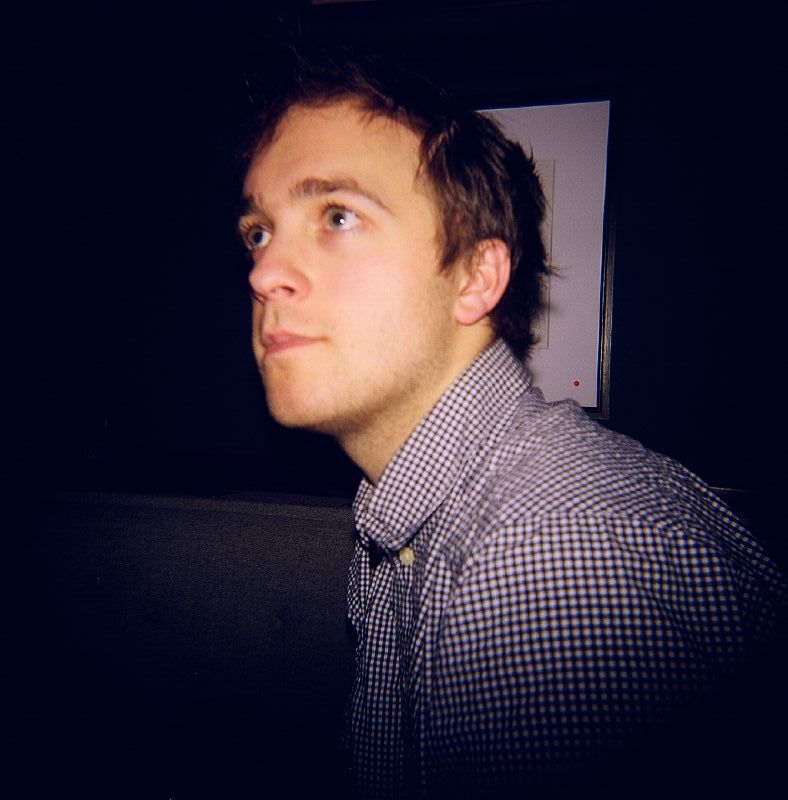
- Mark
- I am writing a PhD at the University of Glasgow entitled "The Poetics of Time in Contemporary Literature". My writing has been published in Type Review, Dancehall, Puffin Review and TheState. I review books for Gutter and The List. I am also an editor and reviewer at the Glasgow Review of Books.